Baseline studies play a crucial role in designing and implementing effective Corporate Social Responsibility (CSR) initiatives. In a rapidly evolving development landscape, organizations are expected to deliver measurable social impact rather than isolated philanthropic activities. A well-conducted baseline study provides the foundation for evidence-based CSR planning, enabling companies to understand community realities and design programs that address genuine needs.
Below are key aspects that highlight why baseline studies are essential for successful CSR programs and sustainable community development.
Foundation for Strategic CSR Planning: Baseline studies act as the starting point for CSR program design. They provide a clear understanding of the existing situation within a community before any intervention begins. By capturing ground realities, organizations can develop CSR strategies that are aligned with local priorities and development challenges.
Understanding Community Needs and Context: Through systematic data collection and field research, baseline studies help identify demographic patterns, socio-economic conditions, infrastructure gaps, environmental concerns, and institutional dynamics. This information ensures that CSR initiatives are based on real community needs rather than assumptions.
Establishing Measurable Benchmarks: One of the primary objectives of a baseline study is to establish clear benchmarks. These benchmarks serve as reference points against which project progress and outcomes can be measured. Without baseline data, it becomes difficult to evaluate whether a CSR initiative has truly created meaningful impact.
Supporting Evidence based Decision Making: CSR investments must be guided by reliable data and insights. Baseline research provides organizations with evidence that informs strategic decision-making, program design, and resource allocation. This reduces the risk of implementing projects that may not be relevant or effective.
Identifying Challenges and Local Opportunities: Baseline studies help uncover underlying challenges that communities face, such as limited access to education, healthcare gaps, livelihood constraints, or environmental issues. At the same time, they highlight existing community strengths and opportunities that can be leveraged for sustainable development.
Enhancing Stakeholder Engagement: An effective baseline study involves interactions with multiple stakeholders including community members, local leaders, government representatives, civil society organizations, and subject experts. This participatory approach strengthens collaboration and builds trust among stakeholders involved in CSR initiatives.
Improving Project Design and Implementation: Insights from baseline studies enable organizations to design targeted CSR programs with realistic goals, appropriate timelines, and feasible implementation strategies. This structured approach ensures that interventions are relevant, scalable, and capable of delivering long-term benefits.
Optimizing Resource Allocation: CSR resources must be utilized efficiently to maximize impact. Baseline studies help corporates prioritize key focus areas, allocate budgets effectively, and ensure that funds are directed toward initiatives that address the most pressing community needs.
Strengthening Monitoring and Evaluation Frameworks: Baseline data forms the backbone of a robust Monitoring and Evaluation (M&E) system. It allows organizations to track progress, measure changes over time, and evaluate whether project objectives are being achieved. This strengthens accountability and transparency in CSR programs.
Enabling Impact Measurement and Reporting: With increasing emphasis on accountability and compliance, corporates are required to demonstrate the outcomes of their CSR investments. Baseline studies make it possible to quantify impact and present credible evidence through CSR reports, sustainability disclosures, and stakeholder communications.
Supporting Sustainable Community Development: CSR initiatives that are built on strong baseline insights are more likely to deliver sustainable outcomes. By addressing root causes and aligning with community aspirations, organizations can create lasting social value and contribute to long-term development.
Building Credibility and Trust: Organizations that invest in baseline research demonstrate a serious commitment to responsible corporate citizenship. Transparent data collection, participatory engagement, and evidence-based planning enhance credibility among partners, regulators, and beneficiaries.
Aligning CSR with Strategic Business Goals: Baseline studies help companies align CSR programs with broader sustainability goals, ESG priorities, and long-term social impact strategies. This alignment ensures that CSR is not treated as a standalone activity but as an integral part of responsible business practices.
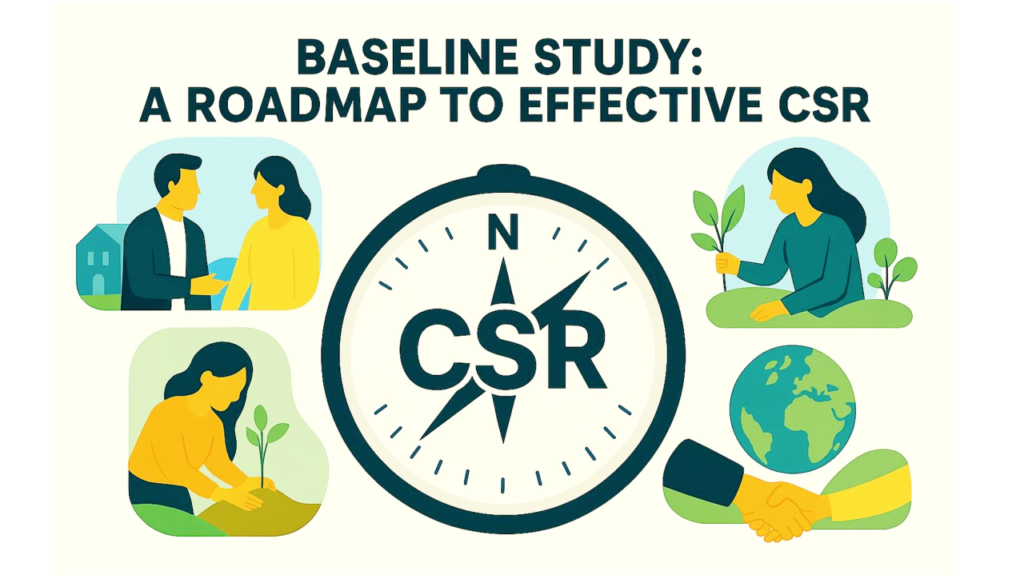
Strengthening Long Term CSR Impact: Ultimately, baseline studies serve as a strategic compass guiding organizations toward meaningful, measurable, and sustainable CSR outcomes. They help transform CSR initiatives from short-term interventions into structured programs that generate lasting benefits for communities.
In conclusion, baseline studies serve as a critical foundation for designing effective and impact-driven CSR initiatives. By providing a clear understanding of the existing social, economic, and environmental conditions within a community, they enable organizations to plan interventions that are relevant, data-driven, and aligned with real needs. Baseline assessments not only help establish measurable benchmarks for monitoring and evaluation but also strengthen transparency, accountability, and strategic decision-making. In an increasingly results-oriented CSR ecosystem, integrating baseline research into project planning ensures that corporate investments lead to meaningful, sustainable community development and measurable social impact.