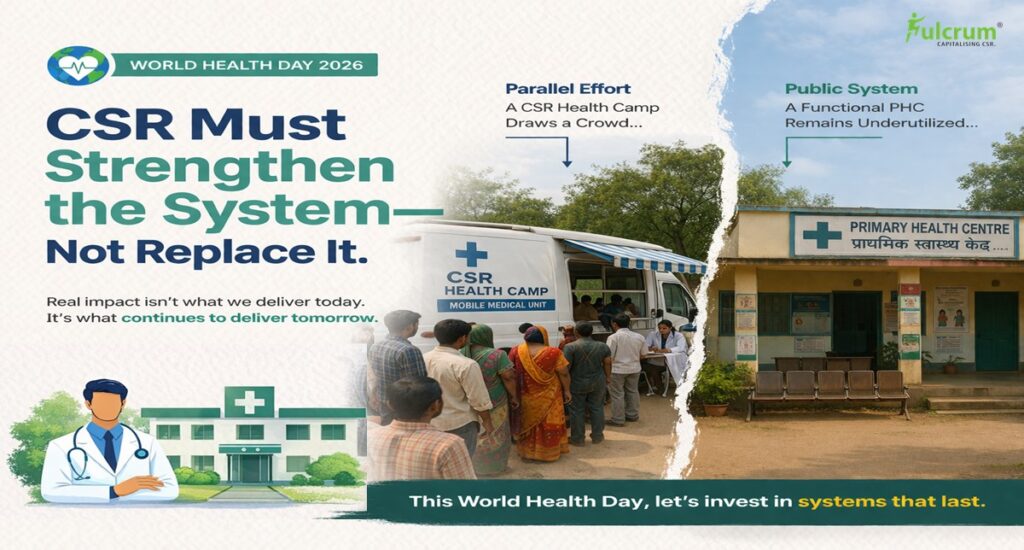
In many parts of India, a CSR health camp draws large crowds, while a nearby government clinic, equally functional, remains underutilized. This contrast is not about intent; it is about approach.
On April 7, World Health Day invites a deeper reflection: are we strengthening public health systems, or unintentionally replacing them?
At a time when India spends over ₹35,000 crore annually on CSR, and healthcare being among the top sectors, the question is not about effort—but about direction.
CSR has played a critical role in expanding healthcare access, especially through mobile medical units, health camps, and infrastructure support. But often, these interventions emerge because Primary Health Centres (PHCs) face gaps – limited staff, inconsistent availability of medicines, or lack of trust among communities. The response, therefore, is to create parallel service delivery.
A mobile medical van is deployed where a PHC already exists. Patients shift to the CSR intervention because it is more reliable in the moment. But this raises a fundamental question: are we solving the gap—or bypassing the system that is meant to solve it permanently?
Because the reality is, when a mobile medical unit stops after 3–5 years, the service often stops with it. But when a PHC is strengthened; with better equipment, trained personnel, reliable supply chains, and improved patient experience, it continues to serve the community long after the CSR intervention has ended.
India’s public health system, supported by frameworks like the National Health Mission, already has the reach and structure. What it needs is targeted strengthening at the last mile, especially when public health spending remains around 2–2.5% of GDP.
The shift, therefore, is clear. CSR must move from delivering services independently to enabling systems to deliver better. This means investing in capacity, not just coverage; in institutions, not just interventions.
The goal should not be to create dependence, but to make external support less necessary over time. CSR must not replace the public health system; it must strengthen it. Because true impact is not measured by what is delivered today, but by whether the system continues to deliver tomorrow. And that is where real, lasting transformation lies.