India’s CSR Expenditure Crosses ₹40,794 Crore in FY 2024-25
India’s CSR Journey Hits a New Milestone: ₹40,794 Crore in FY 2024-25
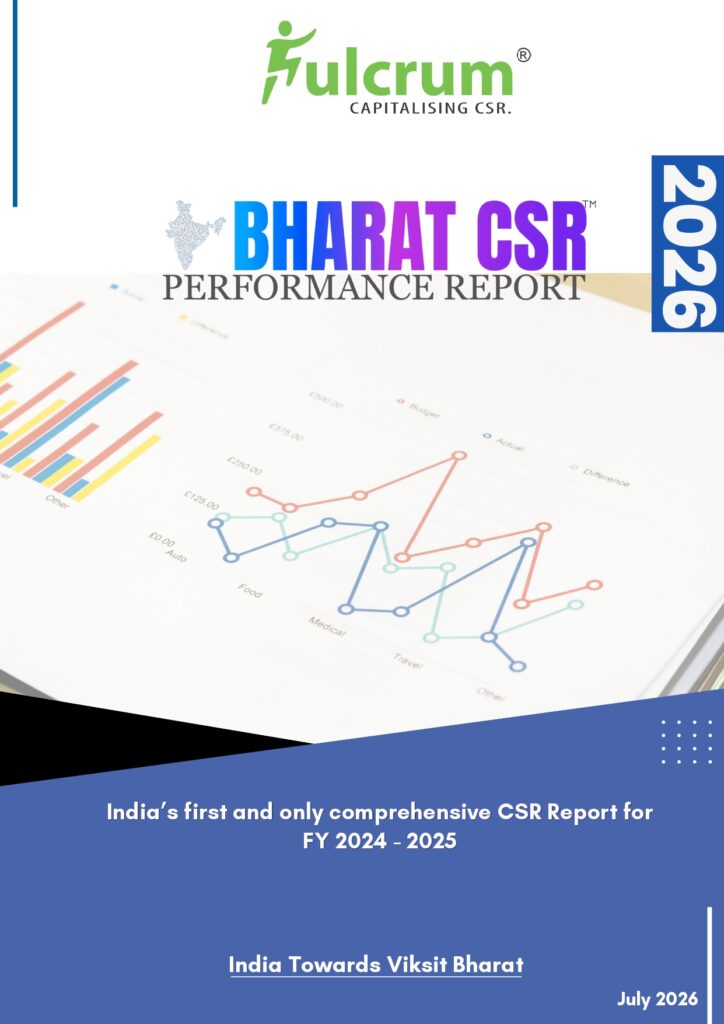
Corporate India’s commitment to social and environmental development reached an all-time high in FY 2024-25, with total Corporate Social Responsibility (CSR) expenditure touching ₹40,794 crore — a robust 17% year-on-year increase. This landmark figure is captured in the Bharat CSR Performance Report 2026, published by Fulcrum — Capitalising CSR, widely recognised as India’s first and only comprehensive CSR report.
Since the Companies Act, 2013 made India the first country in the world to statutorily mandate CSR spending, corporate India has cumulatively invested over ₹2.61 lakh crore in social causes — a journey the Bharat CSR Performance Report tracks year after year with unmatched depth, transparency, and accuracy.
Unlike CSR publications that limit their analysis to BSE- or NSE-listed companies, this report captures the entire universe of companies filing statutory CSR disclosures under the Companies Act, 2013 — making it the most complete and unbiased picture of corporate India’s social investment landscape available today.
Key Highlights from the FY 2024-25 CSR Report
- Total CSR Investment: ₹40,794 crore (+17% YoY)
- Total CSR Projects Implemented: 72,233 (+21% YoY)
- Total Companies Participating in CSR: 29,546, including 1,012 new companies
- PSU vs Non-PSU Spending: PSUs contributed ₹5,957 crore (15%), while Non-PSUs contributed ₹34,837 crore (85%)
- Top 10 CSR Spenders: Together accounted for ₹7,123 crore, or 17% of India’s total CSR spend
These numbers reflect not just regulatory compliance, but a widening base of Indian businesses embracing social responsibility as a core part of governance and nation-building.
Who are India’s Top CSR Spenders in FY 2024-25?
Reliance Industries Ltd. emerged as India’s largest CSR contributor, spending ₹1,309 crore — a 46% jump from the previous year — followed by HDFC Bank Ltd. (₹1,039 crore), Tata Consultancy Services Ltd. (₹949 crore), ONGC Ltd. (₹904 crore), and Tata Steel Ltd. (₹580 crore). Rounding out the top 10 are Indian Oil Corporation, Infosys, Reliance Jio Infocomm, ITC Ltd., and NTPC Ltd.
Notably, the gap between the top two CSR spenders widened dramatically to 26% in FY 2024-25, compared to just 2.5% the previous year — signalling growing differentiation even among India’s largest corporate contributors.
Where Is CSR Money Being Spent? Thematic Trends
Education remains the single largest recipient of CSR funds, attracting ₹13,877 crore — nearly 34% of total CSR expenditure, or one in every three CSR rupees spent in India. Healthcare followed closely with ₹8,531 crore (21% share), while Environmental Sustainability projects saw the sharpest growth of any major theme, surging 40% year-on-year to ₹3,397 crore — a clear signal of corporate India’s accelerating commitment to climate action, biodiversity, and ESG goals.
Livelihood Enhancement (₹2,548 crore) and Rural Development (₹2,477 crore) rounded out the top five thematic areas, which together absorbed 75% of India’s total CSR spend in FY 2024-25.
Interestingly, direct deposits into Government funds (like the PM National Relief Fund and Clean Ganga Fund) fell 6% to ₹943 crore, just 2% of total CSR spend — indicating that companies are increasingly channelling funds directly into on-ground implementation rather than centralised government schemes.
State-Wise CSR Investment: A Story of Concentration and Imbalance
Geographically, CSR spending in India remains heavily concentrated. The top 10 states accounted for 74% of total CSR investment in FY 2024-25, up sharply from 61% the previous year.
Maharashtra retained its position as India’s leading CSR destination for the tenth consecutive year, receiving ₹8,631 crore (21% of the national total), driven by Mumbai’s status as India’s financial capital. Gujarat held on to second place for the third year running, with ₹4,549 crore — but its standout story is an extraordinary 68% year-on-year growth, the fastest of any Indian state, fuelled by its manufacturing, petrochemical, and pharmaceutical industrial base.
Karnataka (₹3,395 crore), Delhi (₹2,753 crore), and Tamil Nadu (₹2,738 crore) complete the top five, each anchored by strong IT, administrative, or manufacturing ecosystems.
At the other end of the spectrum, states and Union Territories like Manipur, Puducherry, Nagaland, Leh & Ladakh, and Mizoram received the lowest absolute CSR investments — highlighting a persistent regional imbalance that the report’s authors flag as an urgent call to action for corporate India.
Per Capita CSR: A Different Lens on Equity
When adjusted for population, the picture shifts. Delhi (₹1,640 per capita) and Chandigarh (₹1,385 per capita) top the list, largely due to their small populations relative to CSR inflows. Meanwhile, Maharashtra and Gujarat are the only states with populations exceeding 50 million to also rank in the per-capita top 10, reflecting a genuine concentration of both absolute and per-resident CSR reach.
At the bottom, India’s most populous states — Uttar Pradesh (₹111), West Bengal (₹118), and Bihar (₹44) — receive the least CSR support per resident, despite Uttar Pradesh ranking sixth nationally in absolute CSR spend. This underscores a core finding of the report: CSR investment tends to follow corporate headquarters and industrial clusters rather than population or need.
Why the Bharat CSR Performance Report Matters
As India moves closer to its Viksit Bharat vision, the Bharat CSR Performance Report 2026 serves as an essential resource for CSR Committees, Board Members, CSR Heads, Policymakers, Government Officials, NGOs, Researchers, and Development Practitioners seeking a credible, data-driven view of the country’s evolving CSR landscape.
By transforming statutory CSR disclosures filed under the Companies Act, 2013 into actionable insights, Fulcrum continues its mission to promote transparency, strengthen accountability, and support smarter, more equitable CSR planning across corporate India.
Download the full Bharat CSR Performance Report 2026 to explore detailed state-wise data, company-level CSR performance, SDG alignment, and thematic spending trends for FY 2024-25 — and discover how your organisation can contribute to a more balanced and inclusive CSR ecosystem across India.