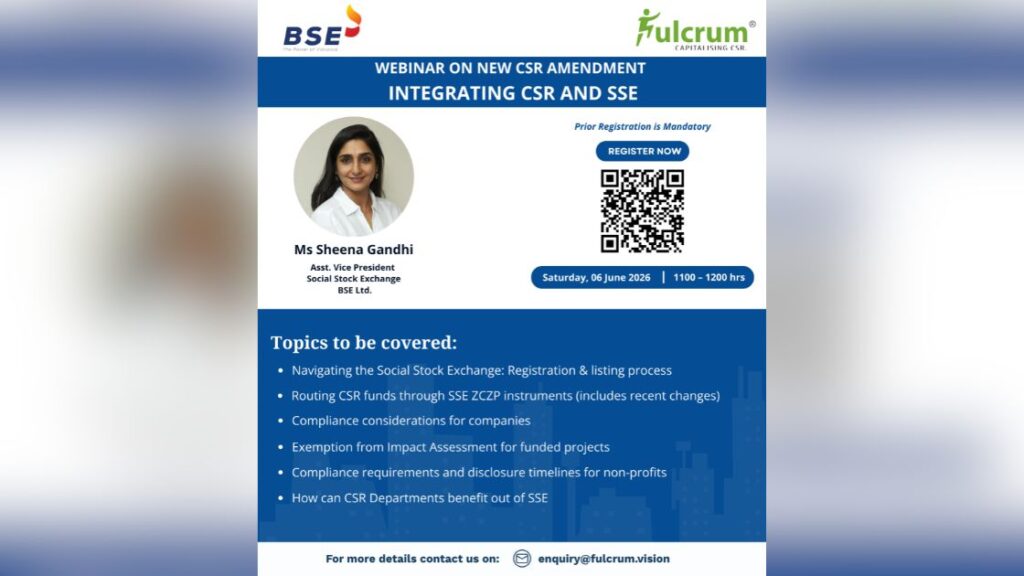
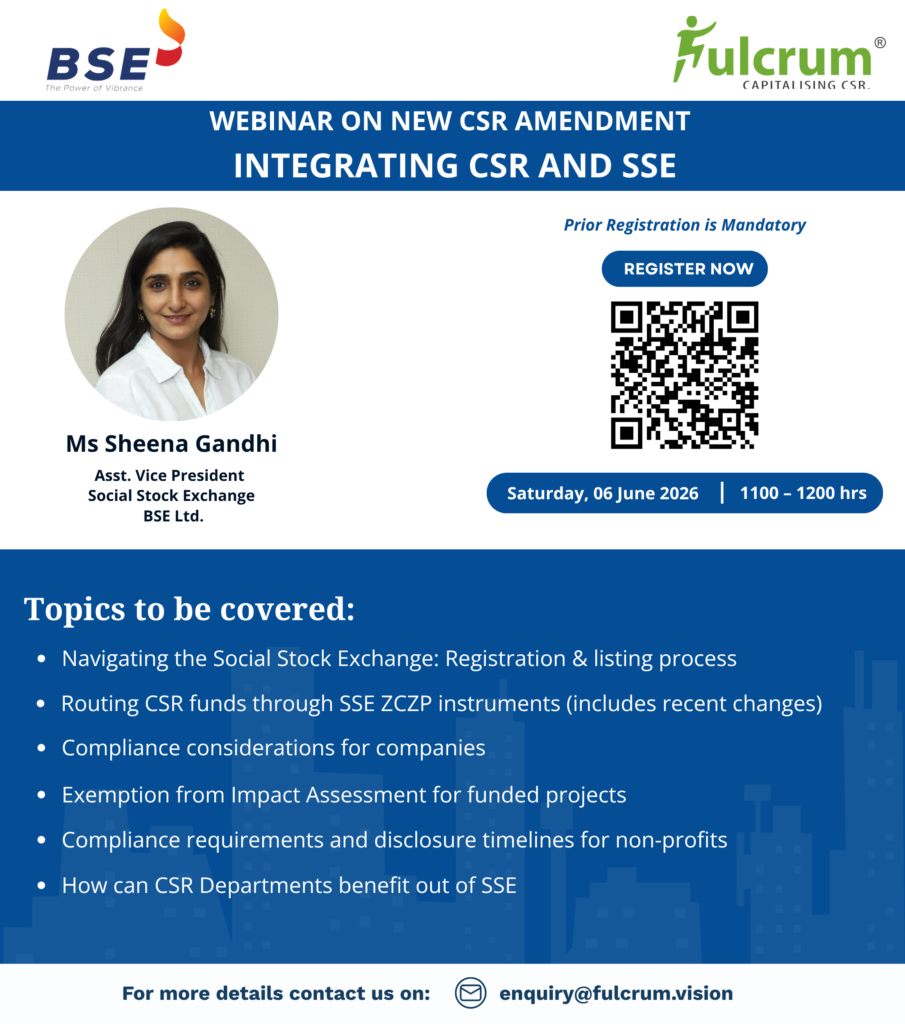
On 06 June 2026, Fulcrum and BSE India jointly organized an insightful webinar on “Integrating CSR and Social Stock Exchange (SSE)”, bringing together corporate leaders, CSR professionals, social enterprises, and development sector stakeholders to explore how the Social Stock Exchange can transform corporate philanthropy and social impact investing in India. The session featured valuable insights from Sheena Gandhi, Assistant Vice President – Social Stock Exchange, BSE India, and Niraj Kumar Lal, Head CSR, Arvind Ltd.
As India continues to strengthen its Corporate Social Responsibility (CSR) ecosystem, the Social Stock Exchange (SSE) offers an innovative, transparent, and accountable platform for channelling funds towards verified social enterprises and non-profit organizations (NPOs).
What is the Social Stock Exchange (SSE)?
The Social Stock Exchange is a dedicated segment of the stock exchange framework established under the regulatory ambit of SEBI. Launched by BSE in 2023, SSE serves as a bridge between social enterprises seeking funding and individuals, institutions, and corporations looking to create measurable social impact.
The platform enables eligible social enterprises to raise funds through market-based mechanisms while ensuring robust governance, transparency, and impact reporting standards. By integrating capital markets with social development objectives, SSE creates a structured ecosystem where philanthropy meets accountability.
Today, the BSE Social Stock Exchange hosts registered non-profit organizations working across multiple development sectors and geographies, creating opportunities for donors and CSR contributors to support impactful projects with greater confidence.
Why SSE Matters for CSR Implementation:
Corporate Social Responsibility in India has evolved significantly since the introduction of mandatory CSR provisions under the Companies Act, 2013. Organizations are increasingly seeking efficient, transparent, and measurable ways to deploy CSR funds.
The Social Stock Exchange addresses several challenges faced by CSR teams:
Access to Verified Social Enterprises:
Organizations listed or registered on SSE undergo eligibility screening and disclosure requirements. This helps companies identify credible implementation partners and reduces due diligence efforts.
Enhanced Transparency and Accountability:
SSE-registered entities are required to maintain periodic disclosures, utilization reports, audited impact reports, and governance-related disclosures. This strengthens donor confidence and improves monitoring of social outcomes.
Standardized Reporting Framework:
One of the major benefits of SSE is the availability of standardized social impact and financial reporting mechanisms, making it easier for CSR teams to assess project performance and demonstrate impact to stakeholders.
Efficient Deployment of CSR Funds:
The Companies (Corporate Social Responsibility Policy) Rules allow companies to deploy up to 10% of their annual CSR expenditure through eligible SSE instruments, creating a new channel for strategic social investments.
Understanding Zero Coupon Zero Principal (ZCZP) Instruments:
A key innovation discussed during the webinar was the Zero Coupon Zero Principal (ZCZP) instrument, a fundraising mechanism specifically designed for non-profit organizations.
Unlike traditional financial securities, ZCZP instruments are created solely for charitable and social purposes. Investors or contributors do not receive interest or principal repayment. Instead, their contribution directly supports social projects while ensuring transparency through stock exchange-based processes.
Key Features of ZCZP Instruments:
- Purpose-driven social financing
- Transparent utilization of funds
- Minimum contribution amount starting from ₹1,000
- Dematerialized issuance process
- Tax benefits under applicable provisions
- No trading or secondary market transactions
- Structured project-based fundraising framework
- Clear impact reporting and disclosures
For CSR leaders, ZCZP instruments offer a unique opportunity to support verified social initiatives through a regulated and accountable ecosystem.
Eligibility Criteria for Social Enterprises:
To ensure credibility, SSE establishes clear eligibility requirements for participating non-profit organizations.
Eligible entities generally include:
- Registered Trusts
- Societies
- Section 8 Companies
- Organizations with a proven track record
- Entities possessing required statutory registrations such as 80G, DARPAN, and CSR-1 certifications
- Organizations demonstrating minimum operational and fundraising thresholds
The focus remains on organizations working toward underserved populations, vulnerable communities, and development priorities aligned with Schedule VII of the Companies Act.
Alignment Between CSR and SSE:
One of the most significant takeaways from the webinar was the strong alignment between CSR Schedule VII activities and the social sectors covered under the SSE framework.
Areas of convergence include:
- Education and skill development
- Healthcare and nutrition
- Women empowerment
- Rural development
- Environmental sustainability
- Livelihood enhancement
- Disaster management
- Social inclusion and community development
- Technology and innovation for social good
This alignment makes SSE a natural extension of existing CSR strategies, enabling companies to diversify their social investment portfolios while maintaining regulatory compliance.
Benefits for Corporate Donors and CSR Teams:
The integration of CSR with SSE creates multiple strategic advantages:
- Improved Governance: Structured disclosures and compliance requirements reduce operational risks associated with social investments.
- Measurable Social Impact: Impact reporting frameworks help organizations track outcomes more effectively and communicate value to stakeholders.
- Reduced Administrative Burden: Standardized reporting and regulatory oversight simplify due diligence and monitoring processes.
- Broader Reach: Companies can access social enterprises operating across diverse thematic areas and geographies.
- Greater Trust and Credibility: The exchange-based ecosystem enhances confidence among boards, auditors, investors, and beneficiaries alike.
Emerging Opportunities for the Development Sector:
The webinar also highlighted a growing pipeline of social projects being supported through SSE across sectors such as:
- Healthcare and disease prevention
- Foundational literacy and education
- Tribal development
- Women’s health
- Climate-smart agriculture
- Renewable energy
- Youth employability
- Rural livelihoods
- Eye health and community healthcare
These examples demonstrate the potential of SSE to mobilize larger pools of capital toward addressing India’s most pressing social and environmental challenges.
The Future of CSR and Social Finance in India:
The Social Stock Exchange represents a significant milestone in India’s journey toward outcome-driven philanthropy and impact-oriented development financing. By combining the rigor of capital markets with the mission of social development, SSE creates a powerful platform for transparency, accountability, and measurable change.
For companies seeking innovative ways to maximize CSR effectiveness, the integration of CSR and SSE offers an opportunity to strengthen governance, improve impact measurement, and support credible social enterprises at scale.
As awareness grows and participation increases, the Social Stock Exchange is expected to play a pivotal role in shaping the future of social impact investing and corporate citizenship in India.
The convergence of CSR and SSE is not merely a regulatory development—it is a transformational opportunity to create sustainable, measurable, and scalable social impact.