Corporate Social Responsibility (CSR) has evolved from a compliance requirement to a strategic driver of social impact. Yet, many organizations still struggle to create meaningful outcomes on the ground.
One of the biggest reasons?
CSR projects are often driven by procurement logic instead of impact logic.
The Core Conflict: Cost vs Impact
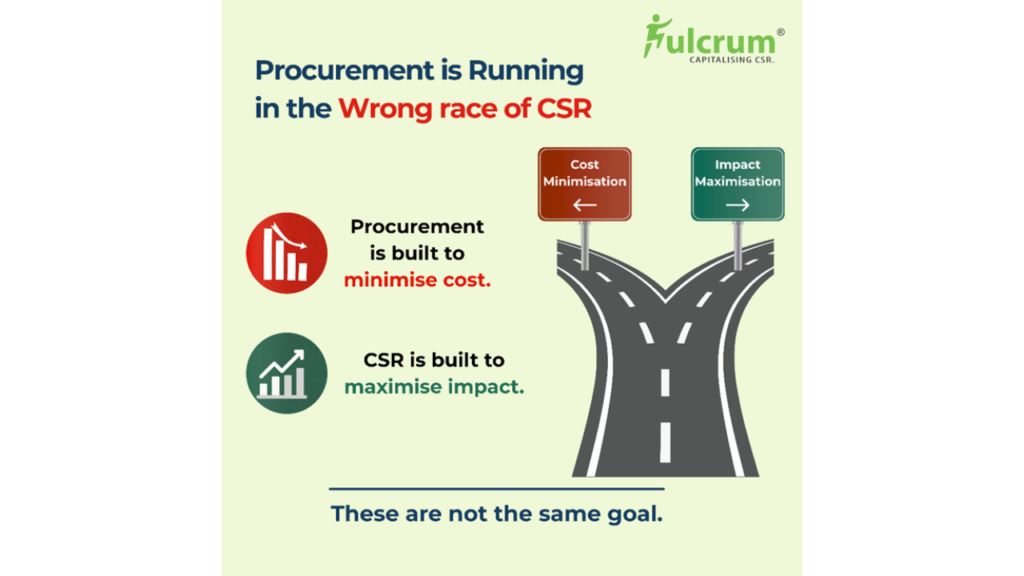
At its core, procurement is designed to minimise costs, while CSR is meant to maximise impact. These are fundamentally different goals.
This misalignment leads to a structural flaw where:
- Procurement focuses on lowest bids
- CSR requires highest impact capability
When cost becomes the primary filter, impact becomes a secondary outcome—or worse, an afterthought.
How Procurement-Led CSR is Hurting Impact
1. NGOs Selected on Cost, Not Capability
NGOs are often shortlisted like vendors supplying office materials—lowest bidder wins.
This results in:
- High-quality NGOs being excluded
- Projects assigned to underprepared partners
- Reduced long-term impact
2. Under-Quoting Leads to Underperformance
The issue of NGOs under-quoting to win projects is highlighted.
What happens next?
- Projects start underfunded from Day 1
- NGOs stretch resources to deliver
- Reports show “success,” but ground reality suffers
The company sees numbers.
The community sees gaps.
3. Impact Functions Treated as Cost Line Items
- Critical services like:
- Monitoring & Evaluation (M&E)
- Impact Assessment (IA)
- Project Management Consulting (PMC)
are often negotiated like routine expenses.
But these require:
- Domain expertise
- Scientific methodologies
- Field-based validation
When budgets shrink, quality collapses, and organizations end up with:
Compliance reports instead of real insights.
Procurement vs CSR: A Mindset Difference
When Procurement Leads:
- Lowest bidder is prioritised
- Budgets are aggressively negotiated
- Activities are designed to fit cost constraints
- Reports focus on compliance
- Impact is missing on the ground
When CSR Leads:
- Partners are chosen for capability and alignment
- Projects are designed for sustainability and outcomes
- Honest reporting includes what isn’t working
- Real impact is created and measured
The Way Forward: Building Impact-Driven CSR Systems
To bridge this gap, organizations must rethink how they select partners and evaluate CSR projects.
1. Joint Evaluation Committees
As suggested on:
- Procurement + CSR teams should co-evaluate proposals
- Decision-making must balance cost and impact
2. Customised CSR Benchmarking
CSR cannot follow traditional vendor benchmarks.
Instead, evaluation should focus on:
- Impact potential
- Field capability
- Sustainability models
3. Quality Over Cost (60:40 Approach)
Adopt a technical-to-financial scoring model (60:40 or 70:30).
This ensures:
- Expertise is valued
- Cost doesn’t dominate decisions
4. CSR Orientation for Procurement Teams
Procurement teams need exposure to:
- Social impact frameworks
- Ground realities
- Evaluation complexities
This builds better alignment.
5. Leadership-Driven Change
This shift must be led by:
- CSR Committees
- Senior Leadership
Without top-down direction, procurement-led thinking will persist.
Conclusion: From Activity to Impact
The real question every organization must ask is:
Are we funding activities, or are we creating impact?
When procurement drives CSR:
- Activities get completed
- Budgets get optimised
- Reports get submitted
But when CSR drives CSR:
- Communities benefit
- Outcomes improve
- Impact becomes measurable and meaningful