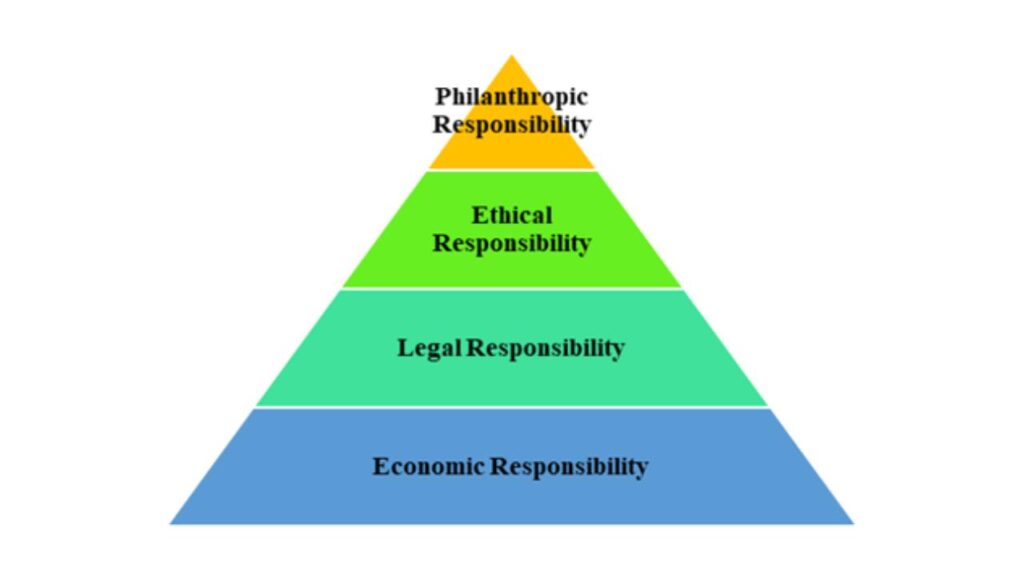
Carroll’s Pyramid of Corporate Social Responsibility (CSR) remains one of the most influential frameworks for understanding how businesses can operate responsibly while achieving long-term success. Developed by Archie B. Carroll, the model organizes corporate responsibilities into four hierarchical layers—economic, legal, ethical, and philanthropic—offering a structured approach to aligning business operations with societal expectations.
At the base of the pyramid lies economic responsibility, which emphasizes that a company must be profitable. Profitability is the foundation upon which all other responsibilities are built, as it ensures survival, growth, and value creation for stakeholders. Without financial stability, organizations cannot invest in social initiatives or sustain ethical practices. In today’s competitive landscape, this responsibility extends beyond mere profit-making to include efficiency, innovation, and delivering value to customers.
The second layer is legal responsibility, which requires businesses to comply with laws and regulations. Companies are expected to operate within the legal frameworks established by governments, covering areas such as labor practices, environmental protection, and corporate governance. Legal compliance not only helps avoid penalties but also builds trust with stakeholders. In modern business, proactive compliance—anticipating and adapting to evolving regulations—has become a key strategic advantage.
Above legal responsibilities are ethical responsibilities, which go beyond what is mandated by law. This layer reflects society’s expectations for fairness, integrity, and respect for stakeholders. Ethical businesses prioritize transparency, avoid harm, and make decisions that align with moral principles. For example, companies today are increasingly expected to ensure fair labor practices across global supply chains, reduce environmental impact, and communicate honestly with consumers. Ethical conduct strengthens brand reputation and fosters long-term relationships with customers and employees.
At the top of the pyramid is philanthropic responsibility, which involves voluntary actions that promote social well-being. This includes charitable donations, community engagement, and initiatives that support education, health, or environmental sustainability. While philanthropy is not required, it reflects a company’s commitment to being a responsible corporate citizen. Modern organizations often integrate philanthropy with business strategy, ensuring that social initiatives also create shared value for both the company and society.
Carroll’s Pyramid remains highly relevant in the context of contemporary frameworks such as ESG (Environmental, Social, and Governance) and Creating Shared Value (CSV). These approaches expand on the idea that social responsibility should not be treated as a separate function but embedded into core business strategy. Companies that successfully integrate CSR into their operations often experience enhanced brand loyalty, improved risk management, and greater ability to attract and retain talent.
In a world where consumers and investors are increasingly conscious of corporate behavior, the pyramid serves as a practical guide for balancing profit with purpose. It encourages organizations to move beyond compliance and actively contribute to societal progress. By addressing all four levels of responsibility, businesses can create resilient strategies that not only drive financial performance but also generate lasting social impact.
Ultimately, Carroll’s Pyramid of CSR offers a timeless and adaptable framework. It reminds organizations that true success lies not just in what they earn, but in how they earn it and how they contribute to the broader community.
https://www.linkedin.com/pulse/carrolls-pyramid-csr-fulcrum-capitalising-csr-1ew7f