India’s social sector has undergone a significant transformation over the past decade. With increasing expectations from donors, corporate partners, and communities, non-profit organisations are evolving from traditional charity-driven models to more structured, data-driven, and impact-oriented institutions.
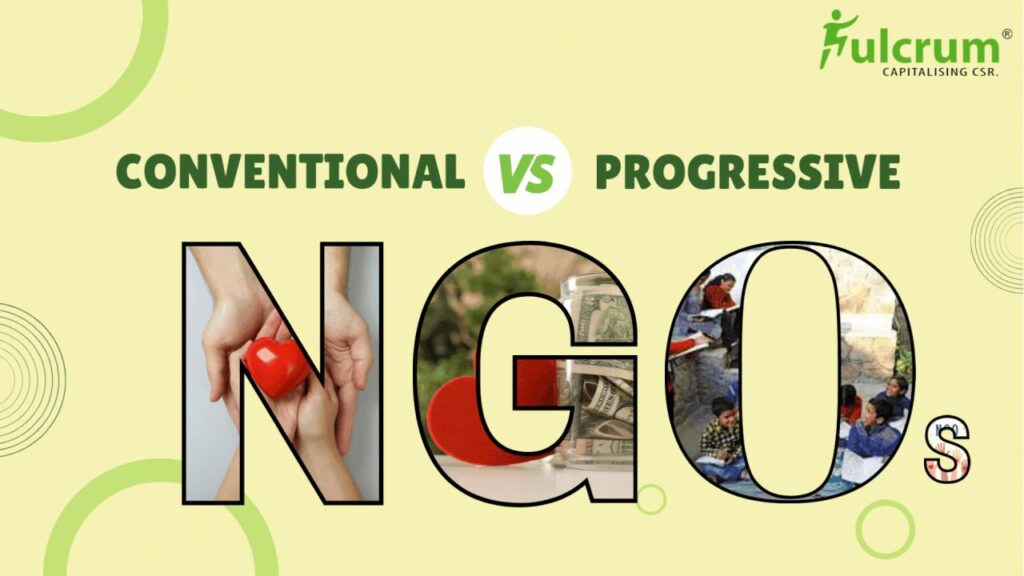
Today, a clear distinction can be observed between conventional NGOs and progressive NGOs. While conventional NGOs often operate with limited resources and traditional approaches, progressive NGOs are embracing innovation, strategic thinking, and evidence-based program design to deliver sustainable social impact.
Understanding this shift is crucial for corporates, donors, and development partners who seek to collaborate with organisations that can create measurable and scalable outcomes.
Funding Approaches: From Limited Sources to Diverse Channels
One of the most significant differences between conventional and progressive NGOs lies in their funding strategies.
Traditional NGOs typically depend on limited funding channels, often relying on personal networks, individual donations, or local charitable contributions. In many cases, trustees or founders take on the role of chief fundraisers, making funding dependent on personal relationships.
Progressive NGOs, on the other hand, actively diversify their funding sources. They engage with multiple funding channels, including CSR partnerships, institutional grants, international funding through FCRA, philanthropic foundations, and impact investors. This diversified funding ecosystem allows progressive organisations to maintain financial stability while expanding the scale of their programs.
Conventional vs Progressive NGOs
Strategic Program Design vs Activity-Based Interventions
Another key distinction lies in how programs are conceptualised and implemented.
Conventional NGOs often focus on activity-driven interventions such as events, campaigns, and short-term initiatives. These activities may generate visibility but often lack long-term sustainability or measurable outcomes.
Progressive NGOs move beyond isolated activities and design comprehensive programs aligned with their organisational vision and mission. Their interventions are based on research, field data, and evidence-driven frameworks, ensuring that programs address root causes rather than symptoms.
Conventional vs Progressive NGOs
By adopting outcome-based approaches, progressive NGOs are better positioned to measure and demonstrate real social impact.
Governance and Decision-Making
Governance structures also differ significantly between traditional and progressive organisations.
In many conventional NGOs, decision-making is highly centralized and intuitive, often resting with a small group of founders or trustees. While this model may work for small-scale initiatives, it can limit organisational growth and responsiveness.
Progressive NGOs adopt more structured and agile governance models. Decision-making is informed by data, team expertise, and collaborative processes, enabling organisations to adapt quickly to emerging challenges and opportunities.
Conventional vs Progressive NGOs
This agility helps progressive NGOs remain relevant in a rapidly changing development ecosystem.
Talent, Capacity Building, and Professionalisation
Human resources play a critical role in the effectiveness of any organisation.
Traditional NGOs often struggle with limited professional capacity, absence of domain experts, and minimal opportunities for staff development. Long-serving employees may not receive regular training or upskilling, which can restrict organisational growth.
Progressive NGOs prioritise professionalisation and talent development. They invest in skilled professionals, subject matter experts, and structured career pathways for employees. Regular training, knowledge-sharing, and leadership development programs help build strong institutional capacity.
Conventional vs Progressive NGOs
Such organisations also recognise the importance of fair compensation and believe that social sector professionals should be paid in line with market standards.
Technology, Innovation, and Digital Transformation
Another defining feature of progressive NGOs is their ability to leverage technology and digital systems.
While conventional organisations may rely heavily on manual documentation and traditional communication methods, progressive NGOs integrate digital tools for monitoring, evaluation, reporting, and outreach.
They also adopt innovative marketing strategies, digital storytelling, and data analytics to enhance program visibility and stakeholder engagement.
From Static Organisations to Scalable Impact
Perhaps the most important difference lies in the vision for growth.
Conventional NGOs often operate in a static mode, focusing primarily on day-to-day operations with limited scope for expansion.
Progressive NGOs are growth-oriented and impact-driven. They continuously strive to move from “good to great” by designing programs that are scalable, replicable, and sustainable.
Conventional vs Progressive NGOs
This forward-looking approach enables them to create long-term solutions to complex social challenges.
The Future of the Social Sector
As the development ecosystem becomes more collaborative and results-driven, the shift toward progressive NGOs is becoming increasingly important. Corporates, donors, and policy-makers are now looking for partners who can demonstrate measurable impact, strong governance, and strategic thinking.
For the social sector to achieve meaningful and lasting change, organisations must embrace innovation, data-driven decision-making, and sustainable program design.
The transition from conventional to progressive NGOs represents not just organisational growth, but a fundamental transformation in how social impact is envisioned and delivered.
https://www.linkedin.com/feed/update/urn:li:activity:7318219537416380416