
Capitalising CSR: Transforming Responsibility into Strategic Impact
In today’s evolving corporate landscape, Corporate Social Responsibility (CSR) has moved far beyond being a regulatory obligation. Forward-thinking organisations now recognise CSR as a strategic opportunity — one that enables businesses to create shared value, strengthen stakeholder relationships, and contribute meaningfully to sustainable development.
However, many organisations still approach CSR as a compliance requirement tied only to statutory spending mandates. This limited view often results in fragmented initiatives that deliver short-term outcomes rather than long-term impact.
At Fulcrum, we see CSR differently.
We believe CSR is not merely a contribution — it is an investment in people, the planet, and purposeful growth. When designed strategically, CSR initiatives can deliver measurable social, environmental, and business value simultaneously. This philosophy forms the foundation of our approach: Capitalising CSR.
Moving from Compliance to Capitalisation
“Capitalising CSR” means transforming CSR from a mandatory activity into a strategic driver of sustainable growth. Instead of focusing solely on regulatory compliance, organisations can leverage CSR to strengthen brand credibility, build community trust, engage employees, and generate measurable social impact.
Over the years, Fulcrum has partnered with corporates across diverse sectors to design and implement impactful CSR strategies that go beyond statutory mandates. From crafting CSR visions and policy frameworks to executing large-scale multi-year programs, our work focuses on creating sustainable solutions supported by measurable outcomes.
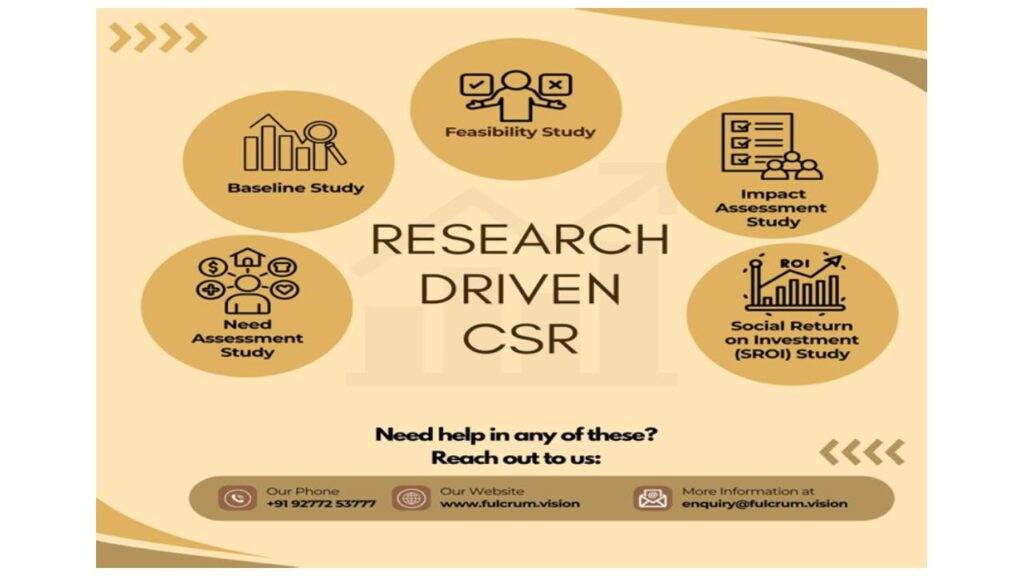
A key aspect of this approach is ensuring that CSR investments deliver Social Return on Investment (SROI) while fostering meaningful community development and organisational value.
Turning Intent into Impact
From our experience, high-impact CSR initiatives are built on three core principles.
1. Define Impact First, Then Activity
Effective CSR begins with clarity of purpose. Instead of starting with activities, organisations must first define the social or environmental impact they aim to create. By aligning initiatives with clearly defined goals, companies can ensure that every program contributes directly to long-term outcomes rather than isolated outputs.
2. Build Evidence-Based Frameworks
Data and measurement are critical to responsible CSR implementation. An evidence-based framework ensures that CSR initiatives are grounded in research, measurable indicators, and continuous evaluation. This approach enables organisations to track progress, measure impact, and refine strategies over time while maintaining transparency and accountability.
3. Engage People: Turn Purpose into Participation
CSR achieves deeper impact when employees actively participate in the journey. Beyond financial contributions, organisations can foster a culture of purpose by encouraging employee volunteering, skill-based engagement, and collaborative initiatives. When people connect with the cause, CSR becomes a shared mission rather than a corporate obligation.
The Way Forward for Strategic CSR
As expectations from businesses continue to evolve, CSR is no longer a peripheral activity. It has become an essential component of responsible and sustainable business strategy.
Organisations that successfully integrate CSR into their core operations are better positioned to build trust, enhance brand reputation, and create long-term value for both society and the business ecosystem.
At Fulcrum, we have seen firsthand that when intent, insight, and impact come together, CSR becomes a powerful catalyst for transformation — benefiting communities and companies alike.
If your organisation is looking to design a high-impact CSR roadmap or strengthen an existing CSR strategy, it may be time to move beyond compliance and start capitalising CSR.
Together, we can transform responsible action into meaningful and measurable impact.
https://www.linkedin.com/feed/update/urn:li:activity:7396381649694797824